


“The Nitroplast Discovery of 2025 changes everything. Scientists confirm a rare event of Endosymbiosis has merged two life forms into one, creating a New Organelle for the first time in a billion years. Is this alien biology? Read the breakthrough.”
By TheLastUpdates Editorial Team | December 9, 2025
We are taught in school that evolution is a slow, lonely game. A fish grows legs. A monkey stands up. Species branch out like a tree, getting further and further apart.
But what happens when two completely different species decide to stop branching out and instead smash together?
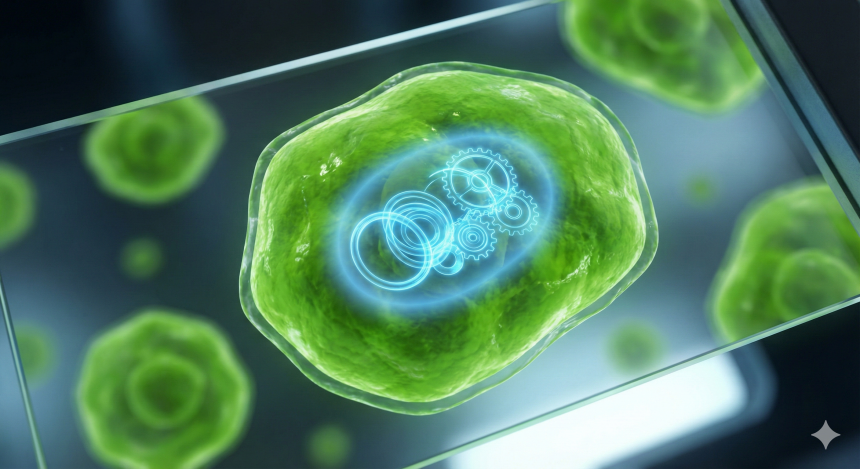
Scientists have just confirmed that for the first time in over a billion years, a complex life form has merged with a bacterium to create a brand-new body part. It’s called the Nitroplast, and it was found hiding inside one of the most boring places on Earth: a common ocean algae often confused with pests.
This discovery is so rare that it has only happened three times in the history of our planet. And it changes everything we know about what it means to be “alive.”
The “Russian Doll” of Biology
To understand why this is a big deal, you have to understand that your body is basically a haunted house of ancient bacteria.
Billions of years ago, a single-celled ancestor of ours swallowed a bacteria but didn’t digest it. That bacteria became the Mitochondria (the powerhouse of the cell). Later, plants swallowed a different bacteria that became Chloroplasts (which allow them to eat sunlight).
Since then? Nothing. For a billion years, nature stopped merging.
Until now.
Researchers studying Braarudosphaera bigelowii, a tiny algae, noticed it was doing something “impossible.” It was pulling nitrogen directly from the air and turning it into food. Animals can’t do that. Plants can’t do that. Only bacteria can do that.
When they looked closer, they found a small blob inside the algae. For years, they thought this blob was just a passenger—a hitchhiking bacteria. But new imaging in 2025 proved otherwise. The blob had stopped being a separate creature. It had thrown away its own DNA. It had synchronized its cell division with the host.
It wasn’t a passenger anymore. It was an organelle.
Why is this “Alien”?
This process is called Primary Endosymbiosis. It is the biological equivalent of a human swallowing a flashlight and suddenly evolving the ability to shoot beams from their eyes.
“It defies the standard rules of individuality,” says Dr. Tyler H., a lead evolutionary biologist. “We usually think of life as ‘Me vs. The World.’ But this algae proves that if you wait long enough, ‘The World’ becomes part of ‘Me’.”
If we found this on Mars, we would call it alien biology. The fact that we found it in the ocean reminds us how little we actually know about Earth.
The “Citrus Pest” Connection
Why does the headline mention pests? Because the closest relatives of these nitrogen-fixing structures are often found in the guts of mealybugs and aphids—common garden pests that destroy citrus crops.
Scientists are now racing to see if these pests are also hiding secret “alien organs.” If we can unlock the genetic code of the Nitroplast, we could theoretically engineer crop plants (like wheat or corn) that grow their own fertilizer. It would end world hunger.
Or, in a more sci-fi scenario, it opens the door to Synthetic Biology. If nature can weld two species together, can we? Could we give humans chloroplasts so we can eat sunlight? (Probably not, but it’s fun to dream).
The Takeaway
The Nitroplast discovery is a humbling reminder. We think we are the peak of evolution because we have iPhones and skyscrapers. Meanwhile, a tiny algae in the Pacific Ocean just figured out how to fuse two species into one, solving an energy crisis that has existed for eons.
Nature is weird. It’s messy. And sometimes, it decides that the best way to survive is to eat your friend and turn them into an engine.
What do you think? Is this the future of evolution, or just a biological freak accident?