





By TheLastUpdates Editorial Team | December 5, 2025
Imagine this: You are a 15-year-old student sitting in the cafeteria. It is Tuesday. You open your lunchbox, pull out a bag of Nacho Cheese Doritos, and take a bite. Suddenly, the school goes into hard lockdown. Sirens blare. Smart locks slam shut. Police units are dispatched with rifles drawn.
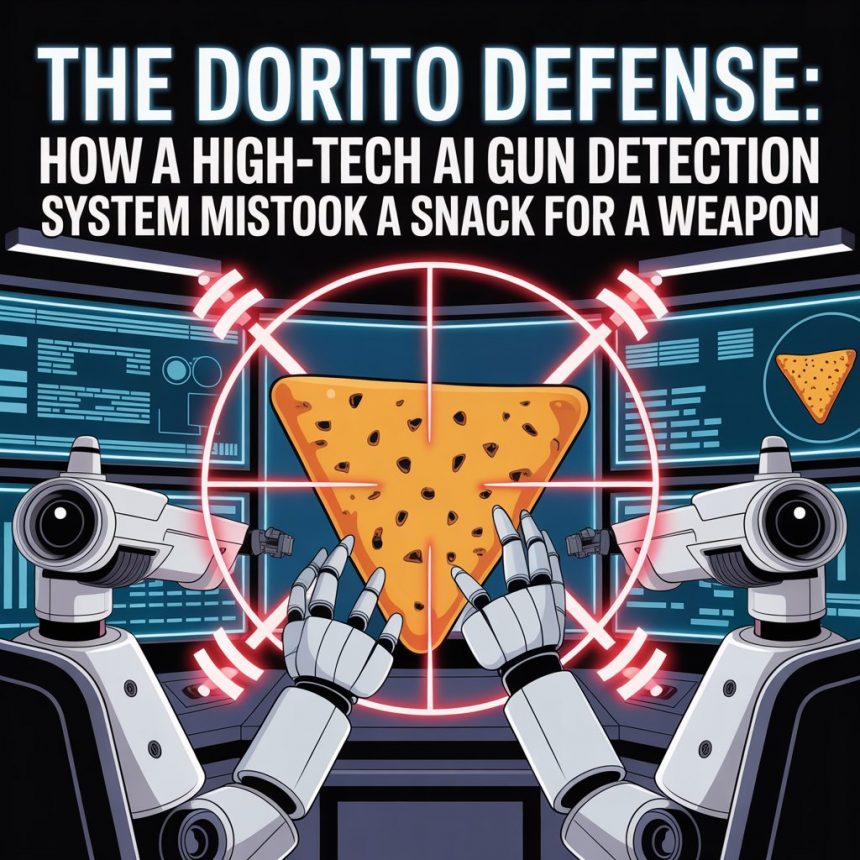
Why? Because a million-dollar Artificial Intelligence camera system decided that the triangular corn chip in your hand was a .45 caliber pistol.
Instances of AI Glitches like this raise serious questions about the reliability of such technology in critical situations.
Such AI Glitches can have severe implications for safety and trust in technological systems.
This isn’t a scene from a cyberpunk comedy sketch. This is the reality of the “Smart Security” boom in late 2025, marked by troubling reports of AI Glitches. In what is quickly becoming known as “The Dorito Incident,” a high school in Pennsylvania has become the epicenter of a global debate about relying on machines to police humans.
The Incident: Code Red for “Cool Ranch”
Understanding AI Glitches in Gun Detection Systems
The incident occurred at approximately 12:14 PM. The school had recently installed a state-of-the-art AI Visual Weapons Detection System. Unlike metal detectors, these systems use existing security cameras and “computer vision” software to scan the hallways for the shape of firearms.
The potential for AI Glitches to trigger unnecessary panic raises serious ethical concerns.
According to the leaked incident report, the AI flagged a “Level 5 Threat” in the cafeteria.
The software identified a student raising a “small, triangular object” to their face. The AI’s algorithm, trained on thousands of images of handguns, interpreted the motion of the hand and the glint of the chip packaging as a “tactical draw” of a weapon.
These AI Glitches highlight the flaws in algorithm design and training data selection.
Within 3 seconds, the system:
-
Alerted the School Resource Officer.
-
Triggered the automated lockdown voice.
-
Sent a snapshot to the local police department.
When officers arrived, adrenaline pumping, they found a terrified sophomore covered in orange dust, holding nothing more dangerous than a half-eaten chip.
How Can AI Be This Stupid?
To understand how a supercomputer can confuse a snack for a sidearm, we have to look under the hood of Computer Vision.
Understanding these AI Glitches helps developers refine their systems to prevent future errors.
AI doesn’t “see” like we do. It doesn’t understand context. It sees a grid of pixels. It looks for edges, contrast, and shapes.
-
The Shape: A handgun slide is often rectangular or slightly tapered. A Dorito is a triangle. Depending on the angle (shadows, lighting), a triangle can look like the grip of a gun or the hammer mechanism.
-
The Motion: The student moved their hand quickly from their side to their mouth. To the AI, this mimicked the speed of a shooter raising a weapon to fire.
The occurrence of AI Glitches is a reminder that human oversight remains essential in automated systems.
-
The Confidence Interval: These systems are set to be “better safe than sorry.” If the AI is 60% sure it’s a gun, it triggers the alarm. It is programmed to accept False Positives (fake alarms) to avoid False Negatives (missing a real shooter).
But as “The Dorito Incident” proves, a 60% confidence rate results in 100% trauma for the students involved.
The implications of these AI Glitches extend beyond individual incidents, affecting broader public trust.
A History of “Hallucinations”
This is not the first time AI has embarrassed itself, though it might be the most viral. The tech world calls these errors “Hallucinations.” Here is a quick timeline of AI failing to understand reality, leading up to the 2025 Dorito disaster:
These historical examples of AI Glitches serve as cautionary tales for future developments.
1. The Bald Head Soccer Ball (2020)
In a Scottish soccer match, an automated AI camera was programmed to track the ball. Instead, it spent 90 minutes zooming in on the referee’s bald head, mistaking the shine of his scalp for the soccer ball. Viewers were treated to close-ups of an ear instead of the goals. Funny? Yes. Dangerous? No.
2. The “Violence” of Tooth Brushing (2023)
Addressing AI Glitches requires collaboration between engineers, ethicists, and lawmakers.
A popular video platform’s moderation AI began flagging videos of people brushing their teeth as “Violent Imagery.” The rapid back-and-forth motion of the hand was interpreted by the algorithm as a stabbing motion.
3. The Copilot Car Crash (2024)
A semi-autonomous vehicle slammed into the back of a truck because the truck featured a realistic painting of an open road on its rear doors. The AI believed the road continued. It did not.
The Dorito Incident, however, marks a darker turn. We aren’t just missing soccer goals anymore; we are pointing real guns at kids because an algorithm got confused by junk food.
As AI technology advances, continued vigilance against AI Glitches is necessary.
The “Panopticon” Problem
Critics are calling this the “Panopticon Effect.” Schools, malls, and workplaces are being turned into high-surveillance zones where every movement is analyzed.
The Privacy Dilemma: If you can’t eat a chip without triggering a SWAT team, are you free? Experts warn that as we rush to automate safety, we are creating a “fragile” society. If a gust of wind blows a dark umbrella the wrong way, a stadium evacuates. If a student holds a black stapler, a school locks down.
We are teaching these systems to be paranoid. And a paranoid AI is a dangerous neighbor.
The Viral Aftermath: #DoritoDefense
As expected, the internet has turned the incident into a meme.
-
#DoritoDefense is trending on X (formerly Twitter) and TikTok.
-
Students are posting videos “disarming” their lunch boxes.
-
Doritos (the brand) has yet to issue an official statement, though their stock saw a bizarre 0.4% bump as “Doritos” became the most searched term on Google for 48 hours.
But for the parents of the student involved, it’s not a joke. They are suing the security company and the school district for emotional distress. Their lawyer released a statement saying: “My client was hungry, not hostile. We cannot live in a world where a craving for cheese constitutes probable cause.”
What’s Next? The Future of AI Eyes
Will this stop schools from using AI? Unlikely. The security industry is worth billions. However, developers are scrambling to patch their code. We can expect “Snack Recognition Updates” rolling out next week.
Developers are under pressure to minimize AI Glitches in future software updates.
Until then, if you are in a high-security zone, maybe stick to safe foods. An apple is round. A sandwich is square. But a Dorito? That’s a weapon of mass distraction.
The ongoing development of AI systems must prioritize preventing AI Glitches.
🧩 Weird Fact of the Day
Understanding and addressing AI Glitches is crucial to building safer technologies.
Did you know that in 2024, a Roomba (robot vacuum) took photos of a woman on the toilet and posted them to a dev-forum for “data labeling”? The AI didn’t know it was a private moment; it just saw “obstacle.” The machine doesn’t care about your dignity, and it definitely doesn’t care about your lunch.
The future of AI hinges on our ability to mitigate AI Glitches effectively.