





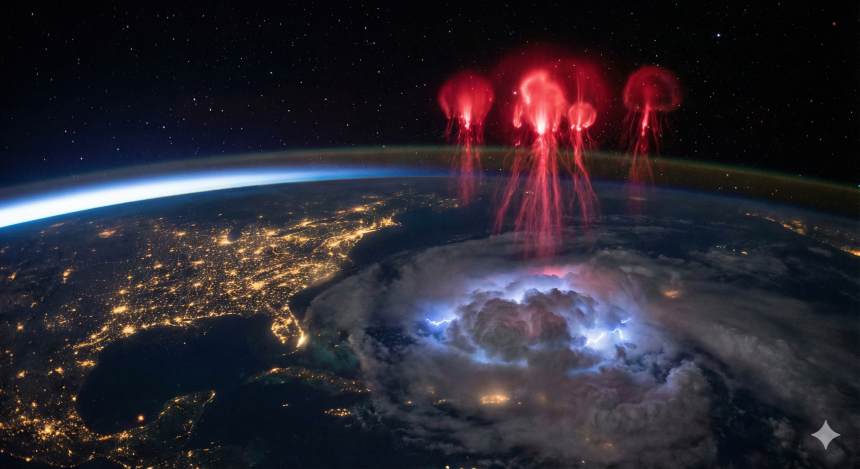
“Pilots called them hallucinations. NASA calls them ‘Red Sprites.’ See the incredible 2025 ISS photos of the giant, red electrical ‘jellyfish’ discovered living above our thunderstorms. #SpaceNews #NASA”
By TheLastUpdates Editorial Team | December 17, 2025
Imagine a night sky lit up by a burst of red light. It shoots high above a thunderstorm. No thunder follows. Just a silent, glowing shape that looks like a ghost dancing in the clouds. This is a red sprite—a rare flash that scientists chase like hidden treasure.
These events fall under Transient Luminous Events, or TLEs. They happen way up in the atmosphere. Red sprites stand out as the most striking ones. They grab attention with their eerie glow and short bursts of life.
This article dives into red sprites. We cover what they are and why they shake up our view of the sky. Plus, we look at NASA’s bold efforts to track these upper-atmosphere lightning shows. From ground cameras to space views, their hunt reveals secrets of Earth’s electric side.
Understanding Red Sprites: Nature’s Upper-Atmosphere Fireworks
Red sprites look like fireworks gone wild. They paint the sky in reds and oranges. But they hide high above storms, out of sight for most folks.
Defining the Phenomenon: More Than Just Lightning
Red sprites are huge electrical bursts. They stretch from 50 to 90 kilometers up. That’s the mesosphere and lower ionosphere—layers where air thins out.
Unlike regular lightning that cracks the ground, these stay aloft. They form column shapes that pulse fast. Witnesses call them upper-atmospheric lightning for good reason. Transient Luminous Events like sprites pop for seconds, then vanish.
You might spot one during a big storm. The red hue comes from excited nitrogen molecules glowing. It’s not fire, but it feels otherworldly. Scientists first caught them on film in the 1980s. Now, we know they link everyday weather to space.
The Mechanism: How Sprites Are Born
A strong lightning bolt below kicks things off. It has to be a positive cloud-to-ground strike. This one dumps a ton of charge into the earth.
That charge builds a wild electric field above the cloud. It ionizes air molecules high up. The result? A sprite ignites like a spark in dry grass.
Think of it as a chain reaction. Tropospheric storms feed energy to the ionosphere. Studies show it takes at least 50 coulombs of charge to trigger one. That’s enough power to light a small city for a bit. Without that punch, no show happens.
Sprite Morphology: Carls, Columns, and Jellyfish
Sprites come in wild shapes. The basic column looks like a tall red pillar hanging down. It branches out at the top, like roots upside down.
Then there are “carls”—round, halo-like rings that spread wide. They pulse and fade quick. Jellyfish sprites twist into dangling arms from a bulbous head. Their tendrils reach low, trailing sparks.
Each form tells a story. Columns form from steady fields. Jellyfish ones follow the strongest bolts. Spotting these helps map how energy flows. Next time you chase storms, watch for these sky dancers. They vary by storm strength and height.
Why Sprites Matter: Impact on Global Climate and Technology
These red ghosts aren’t just pretty. They mix things up in the atmosphere. From chemicals to signals, their reach surprises many.
Atmospheric Chemistry and Ozone Layer Influence
Sprites blast nitrogen oxides into the upper air. These chemicals can tweak ozone levels. Some say they help break down ozone; others think they protect it.
The debate rages on. Energy from a single sprite equals thousands of lightning strikes. That injects reactive stuff high up. It might speed reactions that harm or heal the ozone shield.
We need more data to settle this. NASA’s work hints at small but real effects. Over years, sprites could nudge global air quality. It’s a reminder that storms touch the whole planet.
Terrestrial-Space Weather Coupling
Sprites bridge ground weather and space. They send electric pulses from clouds to ionosphere. This ties Earth’s storms to solar influences.
Picture a wire connecting layers. Lightning below pulls on space currents above. It creates a two-way street for energy.
Dr. Elizabeth Thomas, an atmospheric expert at NASA, puts it this way: “These events show how our weather chats with space. Ignoring them misses half the conversation.” Her view underscores the link. It helps predict ionosphere glitches from storms.
Implications for Aviation and Radio Communication
High-flying planes might feel a sprite’s buzz. Ionized paths alter radio waves. Signals bounce weird during events.
It’s rare, but pilots at 10 kilometers up report odd interference. Long-range comms, like ham radio, see skips too. Sprites create temporary ducts for signals.
Most impacts stay minor. Still, understanding them boosts safety. Nav systems rely on steady air. A sprite could glitch GPS for seconds. Airlines watch this close.
NASA’s Observational Arsenal: Tracking the Ghosts from Above and Below
Catching a sprite takes smarts and gear. NASA teams use eyes on ground, air, and space. They hunt in teams to nail the timing.
Ground-Based Monitoring Networks
Cameras dot the globe for sprite watches. The Global Lightning Network tracks bolts worldwide. It pairs with sky imagers at key spots.
Universities run many setups. Take the one at Langmuir Lab in New Mexico. High and dry, it peers over plains for clear views.
These nets triangulate events. One camera spots the flash; others confirm height. Data syncs with lightning detectors. It’s like a web catching fleeting lights. In 2024 alone, they logged thousands of red sprites.
The Role of High-Altitude Aircraft Platforms
Planes fly right into the action. NASA and NSF fund rides on modified jets. They carry cameras and sensors over Midwest storms.
These birds climb to 15 kilometers. Optics snap high-res shots. Electromagnetic tools measure fields in real time.
Coordination is key. Ground crews call out storm paths. Pilots adjust for the best angle. One flight in summer 2025 caught a jellyfish sprite up close. That data filled gaps in models.
For researchers, tip: Link teams early. Share live feeds to boost hits. It turns guesswork into gold.
Satellite Missions: The View from Orbit
Satellites give the big picture. Past ones like ISUAL on FORMOSAT scanned for TLEs. They mapped sprite hotspots over oceans and land.
New proposals aim higher. A 2026 mission eyes global rates. Orbit lets them cover tropics where storms brew most.
From space, patterns emerge. Sprites cluster near big thunderheads. Frequency hits peaks in summer nights. This view ties local hunts to planet-wide trends. NASA’s got the tools to connect dots.
Key Breakthroughs and Ongoing Mysteries
Progress lights the way, but shadows linger. NASA’s pushes uncover power in these flashes. Yet puzzles remain.
Recent Data Reveals on Sprite Energy Output
Fresh studies clock sprites at huge outputs. One NASA flight measured a burst at 500 gigajoules. That’s like a power plant’s daily hum.
Duration? Most last milliseconds. But chains can stretch seconds. 2025 data from aircraft showed clusters dumping terawatts total.
These finds rewrite books. Early guesses lowballed the punch. Now we see sprites rival solar flares in kick. It shifts how we rate storm impacts.
Unresolved Questions in Sprite Physics
Why do some bolts spark sprites and others don’t? Models falter on energy paths. The cascade from cloud to mesosphere needs tweaks.
Spectral colors vary too. Red dominates, but blues sneak in. What drives that? Chemical yields stay fuzzy. Do they really dent ozone long-term?
Quantifying hits is tough. Sprites hide from radars. We chase ghosts with partial clues. Full answers demand better math and tools.
Future Missions and Instrumentation
Next steps target fine details. Plans include magnetic sensors for field twists. Ultra-fast cameras aim to freeze internal flows.
A 2027 balloon campaign will hover over storms. It packs spectrometers for chemical reads. Ground links will feed real-time tweaks.
These tools promise clarity. Imagine mapping a sprite’s birth frame by frame. It could unlock space weather forecasts. NASA’s lineup excites the field.
Conclusion: Illuminating the Unknown Upper Atmosphere
Red sprites link our stormy world to the quiet heights of space. They show weather’s electric reach goes far beyond clouds. NASA’s hunts turn myths into facts, measuring these sky ghosts with precision.
From first blurry photos to orbital scans, we’ve come miles. Teams now predict and capture events like clockwork. The progress maps a hidden layer of our planet.
Yet the sky holds more secrets. Just above thunder’s roar, electrical dances wait. Keep eyes up during storms—you might spot a red ghost yourself. Share your sightings with science groups. Who knows? Your view could spark the next big find.