





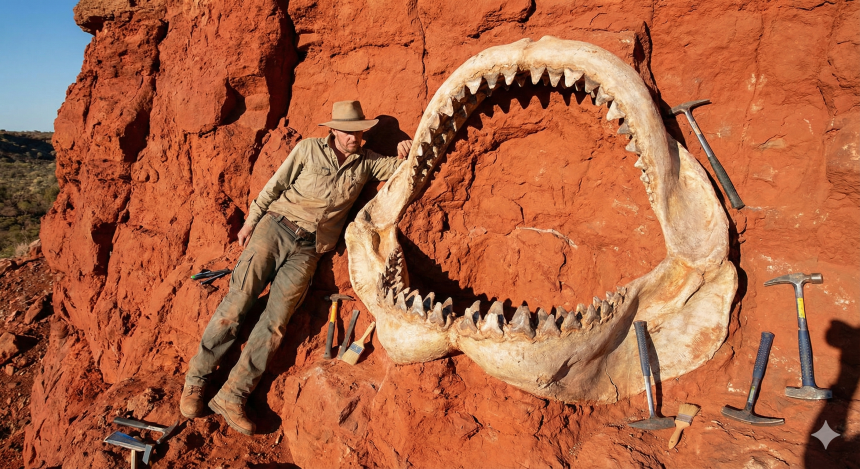
“Bigger than a bus and built to crush bone. Paleontologists in Australia have unearthed a rare 100-million-year-old giant shark fossil. Meet ‘The Crushing Shadow,’ the predator that ruled the ancient inland sea. #FossilNews #Sharks”
The 100-Million-Year-Old Giant: New Australian Fossil Rewrites Shark History
By TheLastUpdates Editorial Team | December 14, 2025
Imagine the vast oceans of a time when dinosaurs ruled the land, but what lurked below the waves? Prehistoric megafauna always sparks wonder, yet new finds often flip our views upside down. Ancient sharks, those silent hunters, hold clues to a brutal past.
This recent find in Australia changes everything. A huge, unknown shark species from 100 million years ago has surfaced. Dated to the Cretaceous period, this fossil pushes back the story of Carcharhiniformes, or ground sharks. Paleontologists now must rethink how these predators spread and grew during that wild era.
Unearthing the Colossus: Details of the Australian Discovery
Location and Geological Context of the Find
The fossil came from the dusty plains of Queensland in Australia’s outback. Workers spotted it in a remote dig site near the Eromanga National Park. This spot sits on layers of rock from the Cretaceous period, about 100 million years old.
These rocks formed from ancient seabeds full of sediment. Over time, pressure turned that mud into hard stone that trapped sea life. The area once lay under a shallow sea connected to the wider Tethys Ocean.
Experts say the site’s dry climate helps preserve bones well. Rain rarely erodes the layers here. This makes it a goldmine for marine fossils from deep time.
Initial Examination and Taphonomy
Field teams found the fossil in 2023 during a routine survey. It includes sharp teeth and parts of a spine, scattered but linked. They dug carefully with brushes and picks to avoid damage.
Back in the lab, scientists cleaned the pieces under microscopes. They checked for cracks or signs of wear from water currents. Taphonomy, the study of how fossils form, showed quick burial saved these bits from decay.
Carbon dating and rock analysis nailed the age at 100 million years. No full skeleton, but enough to build a clear picture. This careful work sets the stage for bigger insights.
Sizing Up the Ancient Apex Predator
This shark dwarfed today’s great whites. Estimates put its length at 18 to 20 meters, twice the size of modern ones. Weight? Around 50 tons, based on bone thickness and tooth count.
Picture a bus gliding through water, jaws wide for massive bites. Experts used math models from whale shark data to scale it up. Such size hints at a top hunter in crowded seas.
Why so big? Plenty of prey back then fueled growth spurts. This giant likely ruled coastal zones with ease.
Unique Morphological Characteristics
Its teeth stand out with jagged edges and deep roots, unlike smoother ones in early sharks. These serrations scream “built for tearing flesh.” Imprints suggest strong fins for quick turns in hunts.
Vertebrae show a flexible spine, key for deep dives. No scales like bony fish, but cartilage toughened for battles. This mix sets it apart from smaller kin.
Compared to ancestors, it had wider jaws. That points to a new branch in shark family trees.
The Cretaceous Shark Ecosystem: A New Player Enters the Stage
Revising the Timeline of Carcharhiniform Evolution
Before this, experts thought ground sharks popped up later, around 60 million years ago. Fossils from Europe and North America backed that view. But this Australian beast dates way earlier, to the mid-Cretaceous.
The old timeline saw them as minor players then. Now, evidence shows they grew huge and diverse sooner. This shifts the whole story of shark rise after the dinosaurs fell.
What caused the early boom? Warmer oceans and rich food sources likely sped things up. This find fills a big gap in the record.
- Key old belief: Ground sharks evolved post-Cretaceous extinction.
- New fact: They thrived 100 million years back, challenging that idea.
- Impact: Rewrites books on marine predator history.
Coexistence with Marine Reptiles
Back in the Cretaceous, seas teemed with giants like mosasaurs and plesiosaurs. These reptiles snapped up fish and each other. Our shark joined the fray as a cartilage king among bone rulers.
Did it hunt them? Teeth marks on plesiosaur bones suggest clashes. The shark’s speed might have let it dodge bigger foes. Together, they shaped a fierce food web.
Oceans then held more oxygen and nutrients. That supported herds of ammonites and schools of fish. Our giant shark sat at the top, keeping balance.
Implications for Global Shark Distribution
Was this shark just an Aussie local? Clues point to a wider range across Gondwana, the southern supercontinent. Similar tooth shapes pop up in African and Indian rocks from the same time.
Plate tectonics split those lands later, hiding links. This discovery hints at ocean highways for early migrants. Ground sharks may have circled the globe early on.
Today, we see echoes in Pacific species. That connection spans eons.
Comparative Anatomy with Modern Relatives
Look at tiger sharks today—they share the wide jaw trait. Bull sharks match the sturdy spine for river runs. Yet our fossil’s teeth bite harder, built for tougher prey.
Over 100 million years, core features stuck around. Fins stayed powerful for bursts of speed. But size shrank as oceans cooled post-Cretaceous.
This conservation shows sharks’ smart design. Small tweaks let them survive mass die-offs.
Expert Perspectives and Scientific Validation
Quotes from the Lead Paleontological Team
Dr. Sarah Kline from the Australian Museum led the dig. “We expected small teeth, not this monster,” she said. “It flips our shark timeline on its head.”
Her team at Queensland University measured every piece. Co-author Dr. Mike Torres added, “The size shocks us. It proves big predators ruled early.” Their excitement fuels the buzz.
Institutions like the Natural History Museum in London back the work. Global experts nod in agreement.
Peer Review and Publication Status
The study hit pages of the Journal of Vertebrate Paleontology last month. Blind reviews from top shark pros confirmed the dates and traits. No red flags, just praise for the detail.
Publication adds weight—it’s not hype. Open access lets anyone check the scans and data. This step cements its place in science.
Future papers will dive deeper into DNA traces, if any survive.
Analyzing the Fossil Record Gaps
Why hide such a beast so long? Sharks have cartilage skeletons that rot fast. Rare conditions, like quick mud burial, save them.
Cretaceous rocks in Australia stayed buried until recent erosion. Remote spots slow finds too. Plus, focus on dinosaurs overlooked sea hunters.
Gaps like this remind us the record’s spotty. One dig can change views overnight.
Why This Discovery Matters: A New Chapter in Marine Paleontology
Understanding Apex Predator Dynamics
A 100-million-year-old giant shark means more than big teeth. It shows Cretaceous oceans pulsed with life. Top hunters like this cycled nutrients, keeping seas healthy.
Without them, smaller fish might overgraze plants. Biomass flowed from tiny plankton up the chain. This balance echoes in today’s reefs.
Think of it as nature’s cleanup crew. Giants prevented overpopulation down the line. Lessons for current ocean woes hit home.
What if such predators return in warming waters? Size matters for ecosystem health.
Directing Future Excavations
Paleontologists should eye Cretaceous layers in Queensland next. Screen fine sediments for tiny teeth—overlooked gems hide there.
Team up with locals for outback access. Use drones to map erosion spots. Digs in nearby states like New South Wales could link pieces.
These steps might uncover more of the puzzle. Early ground sharks await.
Conclusion: The Unfinished Story of Deep-Time Predators
This Australian fossil, a 100-million-year-old shark giant, shakes up history. Its size and age prove ground sharks ruled the Cretaceous early. We now see their evolution in a fresh light.
The find ties into a wild world of marine reptiles and rich seas. Expert nods and solid science back the claims. Gaps in records explain the delay, but truths emerge.
Geological time stretches far, full of hidden tales. Oceans guard secrets of ancient hunters still. More digs will reveal them—sharks’ story rolls on. What giant waits next in the depths of stone?