





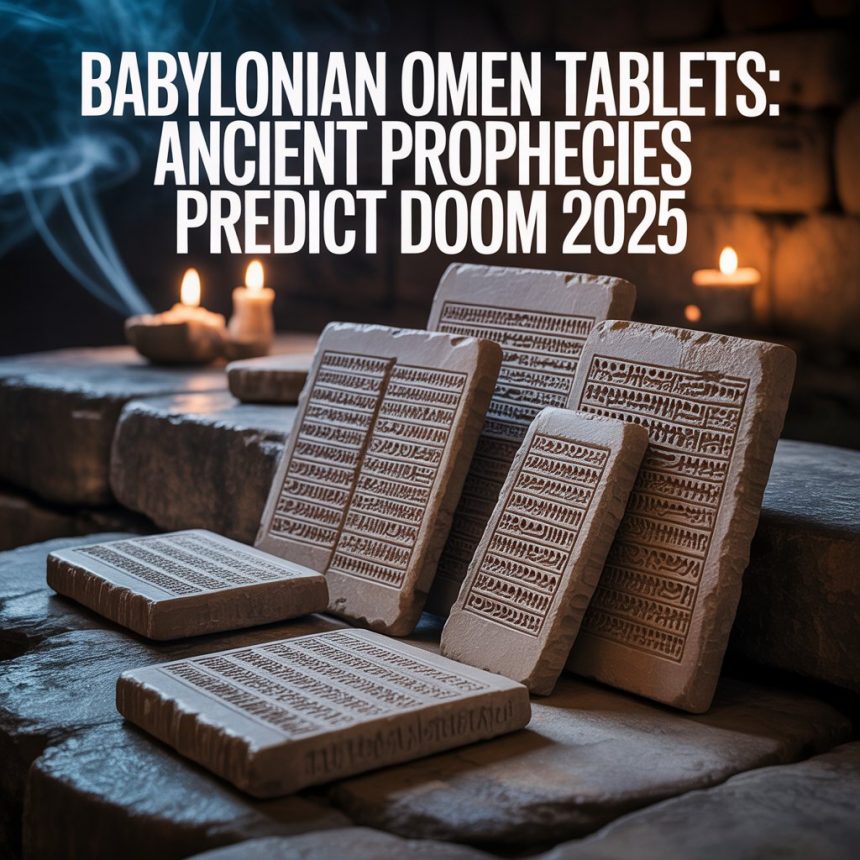
Explore the Babylonian Omen Tablets and their troubling predictions for 2025. Discover the ancient prophecies today.
By TheLastUpdates Editorial Team | December 4, 2025
In the dusty archives of the British Museum, four clay tablets have sat silent for over a century. Covered in the jagged, wedge-shaped script known as cuneiform, they were assumed to be standard administrative records or perhaps mundane receipts from a bygone era.
But recent translations have shattered that assumption.
These tablets are not receipts. They are warnings. And according to the scholars who finally cracked their code in late 2025, they contain some of the oldest and most terrifying omens ever recorded—predictions of kings dying, nations falling, and a world plunged into chaos.
Welcome to the mystery of the Babylonian Lunar Eclipse Tablets.
The Discovery: A Voice from 1900 B.C.
The tablets date back to approximately 1900–1600 B.C., hailing from the ancient city of Sippar in what is now modern-day Iraq. For 4,000 years, the messages inscribed by these ancient astronomers waited to be heard.
In 2025, Andrew George, a renowned Assyriologist from the University of London, along with independent researcher Junko Taniguchi, published a groundbreaking study in the Journal of Cuneiform Studies. They had deciphered the tablets, revealing them to be a comprehensive collection of celestial omens.
The Babylonians were master astronomers. They did not view the night sky as empty space, but as a “celestial writing board” where the gods scribed their intentions. To them, a lunar eclipse wasn’t just a shadow passing over the moon; it was a cosmic alarm bell.
The Prophecies: “A King Will Die, A Nation Will Fall”
The translation reveals 61 specific omens, each triggered by the specific timing, shadow movement, and duration of a lunar eclipse. Unlike the vague horoscopes of today, these predictions were brutally specific and overwhelmingly grim.
Here are some of the most chilling translations found on the tablets:
1. The Death of Leadership
“If an eclipse becomes obscured from its center all at once [and] clear all at once: a king will die, destruction of Elam.”
This omen suggests a sudden, catastrophic decapitation of a government. In the geopolitical volatility of late 2025, the idea of a sudden leadership vacuum resonates with terrifying clarity.
2. The Economic Collapse
“There will be a famine, and people will trade their children for silver.”
Perhaps the most heart-wrenching prediction. It speaks to an economic desperation so severe that the social contract dissolves completely. While we interpret this historically, the metaphor of “trading the future for immediate survival” feels eerily relevant to our modern climate and economic crises.
3. The Pestilence
“If an eclipse occurs in the evening watch, it signifies pestilence.”
Coming off the heels of the global pandemics of the 2020s, the mention of “pestilence” strikes a nerve. The Babylonians believed that the timing of the eclipse determined the nature of the disaster. An evening eclipse meant disease; a morning eclipse often meant war.
4. The Dog’s Omen
“A dog will go mad, and nobody whom it bites, whether male or female, will survive.”
This is a clear ancient reference to rabies, but in the context of “viral news,” it reads like the script of a modern zombie horror film. It reminds us that the ancients feared the “invisible killers” (viruses) just as much as we do today.
The “Substitute King” Ritual: How They Cheated Death
One of the most fascinating aspects of this discovery—and something that adds a bizarre layer to the story—is how the Babylonian kings tried to dodge these prophecies.
The Babylonians were pragmatic. They believed the gods’ signs were warnings, not final judgments. If the tablets predicted “A King Will Die,” the King didn’t just sit around waiting for the end. He initiated the Substitute King Ritual.
The Scapegoat Sovereign
Here is how it worked:
The real King would officially “abdicate” the throne and go into hiding.
A commoner, often a prisoner or someone of low status, was dressed in royal robes and placed on the throne.
This “Substitute King” would be treated like royalty for a set period (usually 100 days). He would eat the best food and drink the best wine.
The cosmic “bad luck” or “doom” meant for the King would theoretically fall upon this substitute.
At the end of the danger period, the Substitute King was… executed.
The real King would return, safe and sound, having “tricked” the gods.
It was a brutal, bloody, but logically consistent way to hack the system of celestial doom.
Why This Matters in 2025
You might be asking, “Why should I care about 4,000-year-old clay tablets?”
The answer lies in the cyclical nature of human fear. In 2025, we look at AI glitches, climate shifts, and political instability as our “omens.” We don’t read sheep livers or watch the moon’s shadow to predict the stock market, but we are just as desperate for certainty as the Babylonians were.
These tablets prove that humanity hasn’t changed. We are still looking up, terrified that the sky is about to fall, trying to find patterns in the chaos.
The Science vs. The Superstition
NASA can now predict eclipses to the second for the next ten thousand years. We know why they happen—orbital mechanics, not angry gods. Yet, when the moon turns blood red, a primal part of the human brain still shivers.
The decoding of these tablets in 2025 serves as a time capsule. It is a message from our ancestors saying: “We were scared, too. We tried to control our fate. Good luck with yours.”
Conclusion: The Last Update from Babylon
The discovery of the Sippar tablets is one of the most significant archaeological finds of the decade. It gives voice to the fears of a civilization that laid the groundwork for modern mathematics and astronomy.
While we (hopefully) won’t see anyone trading children for silver or executing substitute kings this year, the “Babylonian Doom” reminds us of the fragility of civilization. Whether it’s 1900 B.C. or 2025 A.D., we are all just one “bad omen” away from chaos.
What do you think? Are these ancient warnings mere superstition, or did the Babylonians understand cycles of history that we have forgotten?
Found this story weird? Check out our Mysteries section for more ancient enigmas, or visit Tech Glitches to see how modern technology is creating its own bad omens.